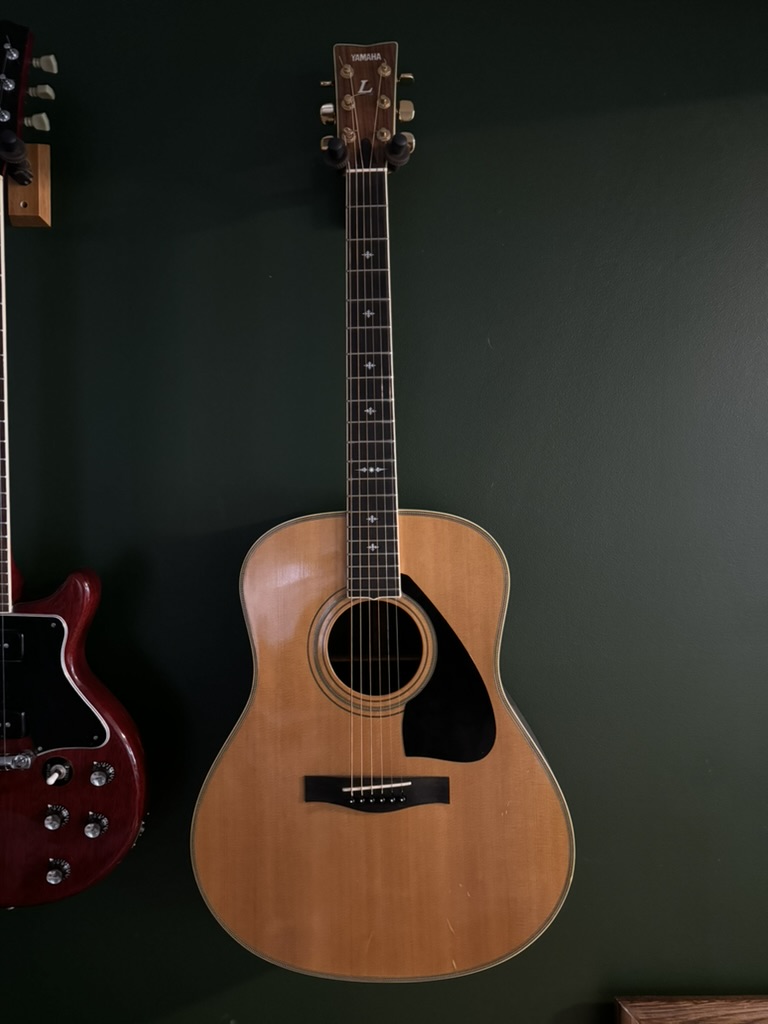
In 1978, Yamaha made a quiet and largely undocumented decision: they would begin producing a second line of their prestigious L-series acoustic guitars outside of Japan. The location was Taiwan, and the experiment was built on a simple premise — could Taiwanese craftsmen build instruments of the same quality as Yamaha's celebrated Japanese production? The answer, it turned out, was yes.
This Taiwan L-series ran in parallel with the Japanese line as a dedicated export range, comprising models including the L-5A, L-10A, L-15A, L-20A and L-25A. All were fully solid construction, handbuilt by craftsmen who — by most accounts — poured a particular intensity into the work. As one longtime Yamaha collector put it: "When it comes to personality, the Taiwan-made models win. Perhaps it's the aging of the wood. Perhaps the Taiwanese craftsmen wanted to show the Japanese owners exactly what they were capable of." Production ceased in 1984 — a year before the Japanese L-series ended — leaving a narrow, well-defined window of manufacture.
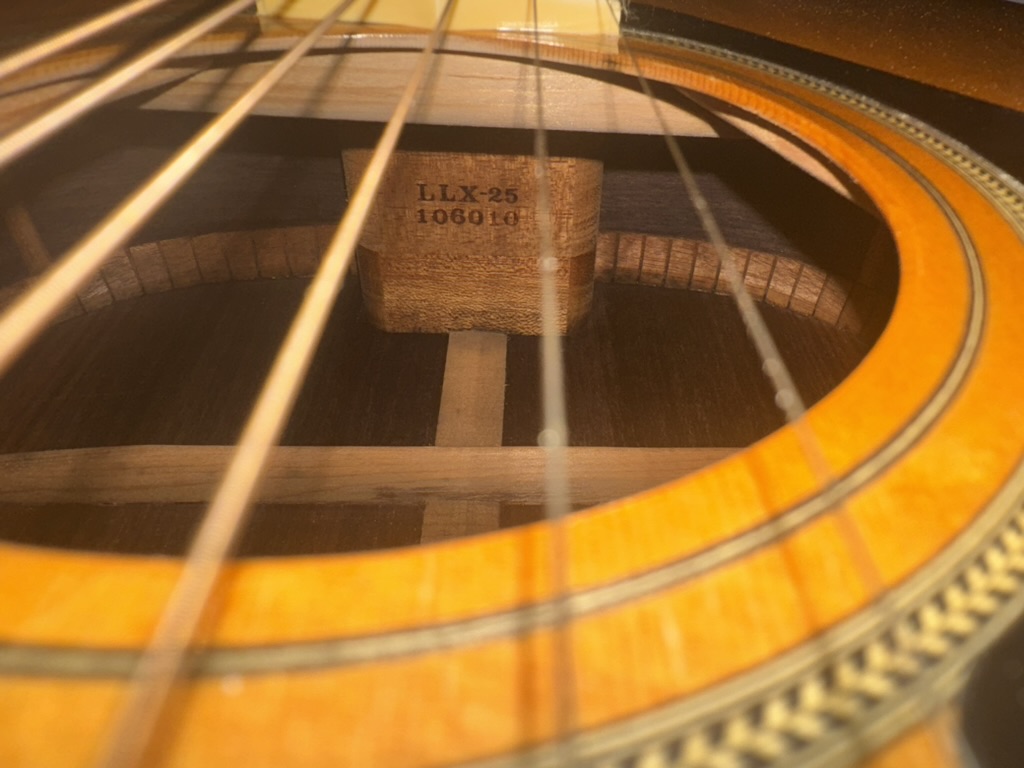
And then there is this guitar. The LLX-25 — a model that, according to Yamaha's own records, does not exist. Contact Yamaha with the model number stamped clearly on the interior brace, serial 106010, and they will tell you there is no such model. The "X" suffix in Yamaha's naming convention denotes an electro-acoustic instrument — and yet this guitar has no electronics, no pickup cavity, no endpin jack. Whatever the X meant here, it wasn't that.
The most plausible explanation is that this guitar represents a prototype or special commission from the Taiwan outsourcing programme — a model built during a period when Yamaha was still working out exactly what this export range would be, potentially intended to receive electronics that were never fitted, or built to a specification that never made it to the official catalogue. The "LL" double-L prefix suggests it was conceived as the jumbo-body variant of the standard L-25. Whatever its intended path, this example arrived fully acoustic, fully handmade, and entirely without a paper trail.
It is, in every meaningful sense, the guitar Yamaha never made — except that they did, and here it is.