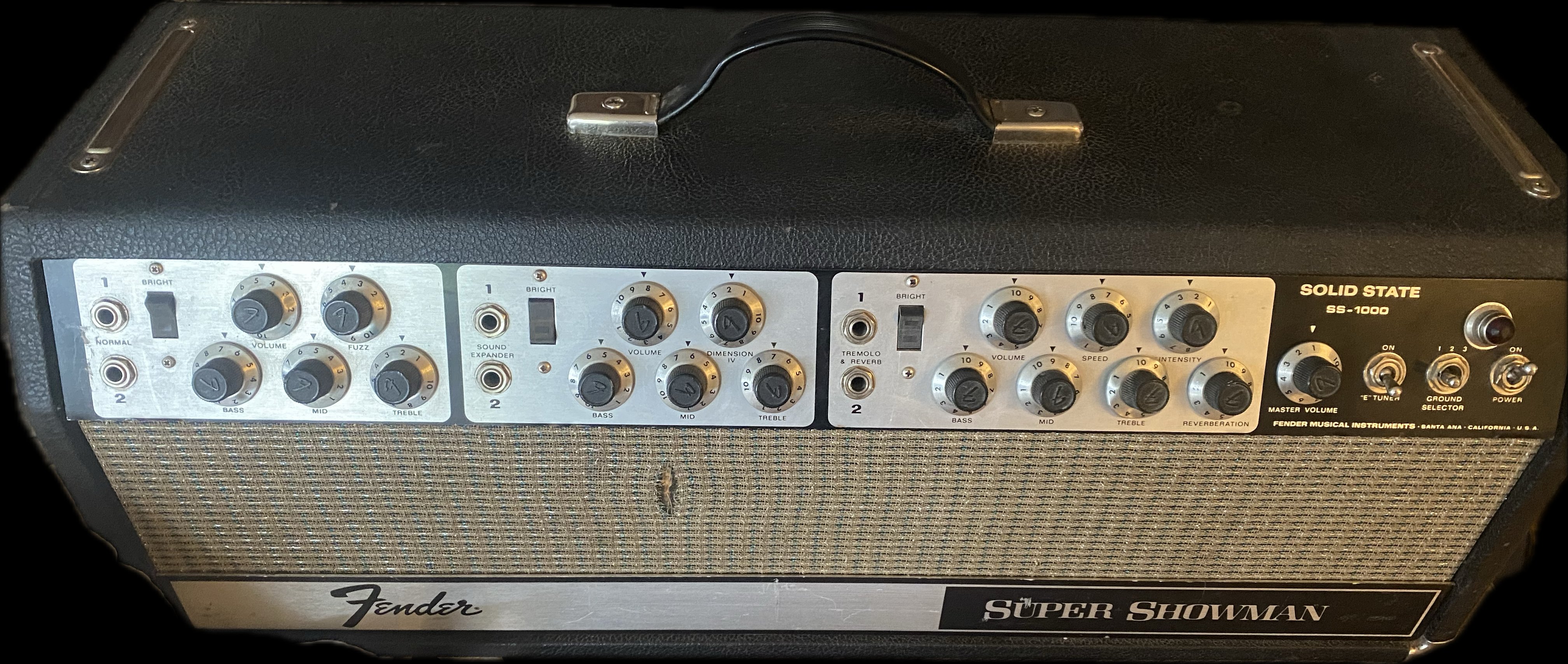
By 1969, CBS had owned Fender for five years and was determined to prove it could do what Leo couldn’t — build a solid-state amplifier worthy of the Fender name. The Super Showman SS-1000 was their most ambitious attempt. It was also, depending on who you ask, their most spectacular miscalculation.
To design it, they hired Seth Lover — the man who invented the humbucking pickup at Gibson — along with former Gibson engineer Richard Chauncey Evans. The pedigree was impeccable. The result was genuinely extraordinary, and the market ignored it almost completely.
The concept was ahead of its time in ways that only became obvious later. The SS-1000 was purely a preamp — a “brain,” in Fender’s own language — with no power amplification of its own. That lived in the speaker cabinets. The XFL-1000 held four 12-inch speakers driven by two 70-watt solid-state power amps; the XFL-2000 ran eight 10-inch speakers at the same wattage. The idea was that you could keep adding powered cabinets until you had the coverage you needed, with the power amp physically as close to the speakers as possible. It was, in other words, the architecture that would eventually become standard in live sound — powered speakers, distributed amplification, modular scaling. Fender had it in 1969. The full rig with two cabinets cost $1,695. Nobody bought it.
The preamp itself is a genuinely bewildering piece of engineering. Three channels, each with its own character. Channel one runs Volume, Bass, Mid, Treble, and Fuzz — the first fuzz circuit ever built into a Fender amplifier. Channel two replaces the fuzz with the Dimension IV Sound Expander, an oil-can delay effect built around Tel Ray’s electromechanical technology, with a small motor running continuously inside the chassis. Channel three handles Tremolo and Reverb, with its own Speed, Intensity, and Reverberation controls. A Master Volume ties all three together. There is also a built-in E-tuner, which in 1969 was a genuine novelty. The whole chassis runs on 49 transistors and 19 diodes, not a tube in sight.
The entire solid-state line was discontinued in 1971. Two years. The Super Showman was too expensive, too complicated, and too far ahead of where guitarists’ heads were at. Players wanted tubes. They still do. The SS-1000 became one of the great footnotes — a machine that was right about almost everything and rewarded for none of it.
This example is the preamp head only, sitting in the collection without its powered cabinets. It doesn’t need them to make its point.